
Living Collection · Individual record
Siphonochilus aethiopicus
Low Ash #1
This was the last firm, dormant rhizome in our ash trial. Its eventual emergence is a useful individual observation. The pot label lets us retain that history without turning it into proof that ash caused the result.
- Scientific name · family
- Siphonochilus aethiopicus (Schweinf.) B.L.Burtt · Zingiberaceae
- Established individual label
- Low Ash #1 · One of three pots assigned to the low-ash group
- Recorded experimental input
- Low-ash protocol: 2.5 g per pot, owner-reported group application. No treatment effect is established.
- Recorded status
- WATCH / EXPERIMENT · Emergence confirmed October 25 · Present health and survival need observation
Latest recorded milestone
On October 25, Stephen confirmed that Low Ash #1 had emerged. That resolves the tentative interpretation of a small green projection in the previous day's photograph. It does not establish the biological first-emergence date or the plant's condition today.
Observe only and preserve the experiment. The next useful evidence is an external, label-visible record of the current crown, shoots and leaves. This page does not authorize repeat fertilization, rhizome excavation or changes to the container, substrate or treatment.
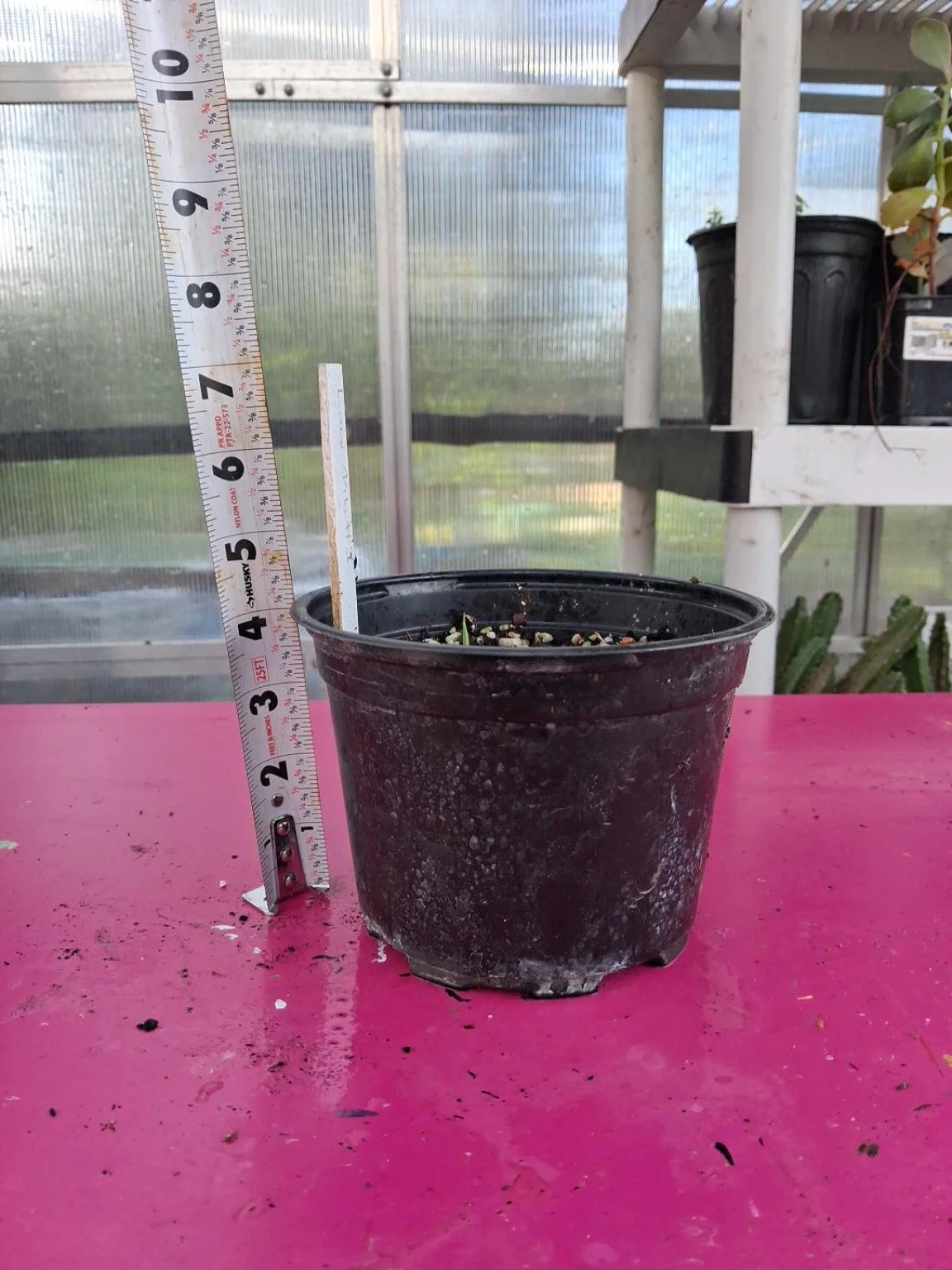
The representative short nursery pot measured by Stephen was approximately 6 inches across the top and 4 inches tall. Those are cohort-level reference dimensions, not a measured capacity or confirmed dimensions for this individual. Earlier descriptions of these containers as one-gallon pots were corrected.
Dated history
The rhizome shipment arrived
The nursery received a group of rhizomes supplied as cultivated Siphonochilus aethiopicus. The later tracked cohort comprised eighteen pots. The arrival photographs do not establish which individual rhizome became Low Ash #1.
Assigned to the low-ash group
Twelve still-dormant pots were assigned to control, low-, medium- and high-ash groups, with three pots per group. The recorded low-ash input was 2.5 g per pot. Six plants that had already emerged were excluded from the treatments. A randomization method and equal initial rhizome sizes were not documented in the reviewed records.
Still dormant, with a firm rhizome
Stephen inspected the remaining dormant rhizome and found it firm; the subsequent label correction identified it as Low Ash #1. Firmness was an observation, not a guarantee of viability. Further disturbance was withheld while the pot was watched.
A small projection was photographed
The owner-labeled frame records a tiny green projection near the substrate surface. At that stage, its interpretation as emergence was tentative. The image is one of a larger labeled-pot census; the white tag alone does not independently establish every part of its identity.
Fertilization added another variable
Stephen later confirmed fertilizing the Siphonochilus group on this date, following the previously recommended approach. Whether Low Ash #1 received fertilizer, its actual product and dose, exceptions and watering-in remain unresolved. The protocol reference is not a measured individual application record. The order of photography and fertilization is not established here.
Emergence was owner-confirmed
Stephen explicitly confirmed that Low Ash #1 had emerged. Its exact first-emergence date remains unknown. No later individual shoot measurement, current-health census, flowering, seed production or propagation outcome is established in this source review.
Trial context, with its limits
Low Ash #1 belongs to the low-ash group. These historical outcomes come from the owner's October 25 correction; they count whether pots ever emerged, rather than how many plants are healthy now.
On a narrow screen, the table scrolls horizontally. Its container can receive keyboard focus.
| Treatment protocol | Initial pots | Ever emerged | Confirmed rot losses |
|---|---|---|---|
| Control · 0 g ash | 3 | 3 | 0 |
| Low · 2.5 g ash per pot | 3 | 2 | 1 · Low #3 |
| Medium · 5.0 g ash per pot | 3 | 2 | 1 · Medium #1 |
| High · 10.0 g ash per pot | 3 | 3 | 0 |
Ten of twelve experimental pots had emerged at some point, with two confirmed trial rot losses. Six additional plants emerged before treatment, making sixteen ever-emerged plants in the tracked eighteen-pot cohort. The pre-treatment plants are not extra ash-trial replicates.
Three pots per treatment, different starting rhizomes, variable emergence timing and rot losses limit interpretation. Group fertilization on October 24 is an additional influence on later growth comparisons. These records do not establish that ash caused emergence, prevented rot or improved growth.
What remains unresolved
A useful follow-up would record the readable pot label, current survival, shoots, expanded leaves, visible crown and any root escape, without unpotting. Root escape reported for other labeled plants must not be copied into Low Ash #1's history.
For this individual, exact substrate composition and volume, water history, lighting, temperature, relative humidity, rhizome dimensions and starting mass have not been established in this page's source review. No controlled environmental optimum can be inferred from the photograph.
Fertilizer recipient coverage and actual dose remain missing. The previously proposed pot-within-pot root extension was not confirmed implemented for Low Ash #1. A proposed action, an observation request and a completed intervention retain separate statuses.
Evidence and interpretation
- Published evidence: Kew's Plants of the World Online accepts Siphonochilus aethiopicus in Zingiberaceae and describes it as a rhizomatous geophyte of tropical and southern Africa, primarily in the seasonally dry tropical biome. This supports species context, not independent authentication of this specimen.
- Nursery observations: the dated SM-0054 accession journal, corrected owner labels and original October 24 photograph; emergence was separately confirmed by Stephen on October 25.
- Interpretation: the individual record preserves a late emergence within a small trial. It is not a replicated demonstration of efficacy.
- Hypotheses: initial rhizome condition, seasonal cues and growing conditions could influence emergence; their effects have not been isolated.
- Unknowns: exact first-emergence date, present health, several individual inputs and the cause of the differing outcomes.
Read the nursery investigations · Explore the Living Collection · Botanical Library & Journal