
What I'm observing
Dated cultivation notes from Traphouse Nursery: methods, changes, photographs and questions. A visible response is an observation. Its cause remains a question until the evidence supports an answer.
Impatiens: following a cross beyond pollination
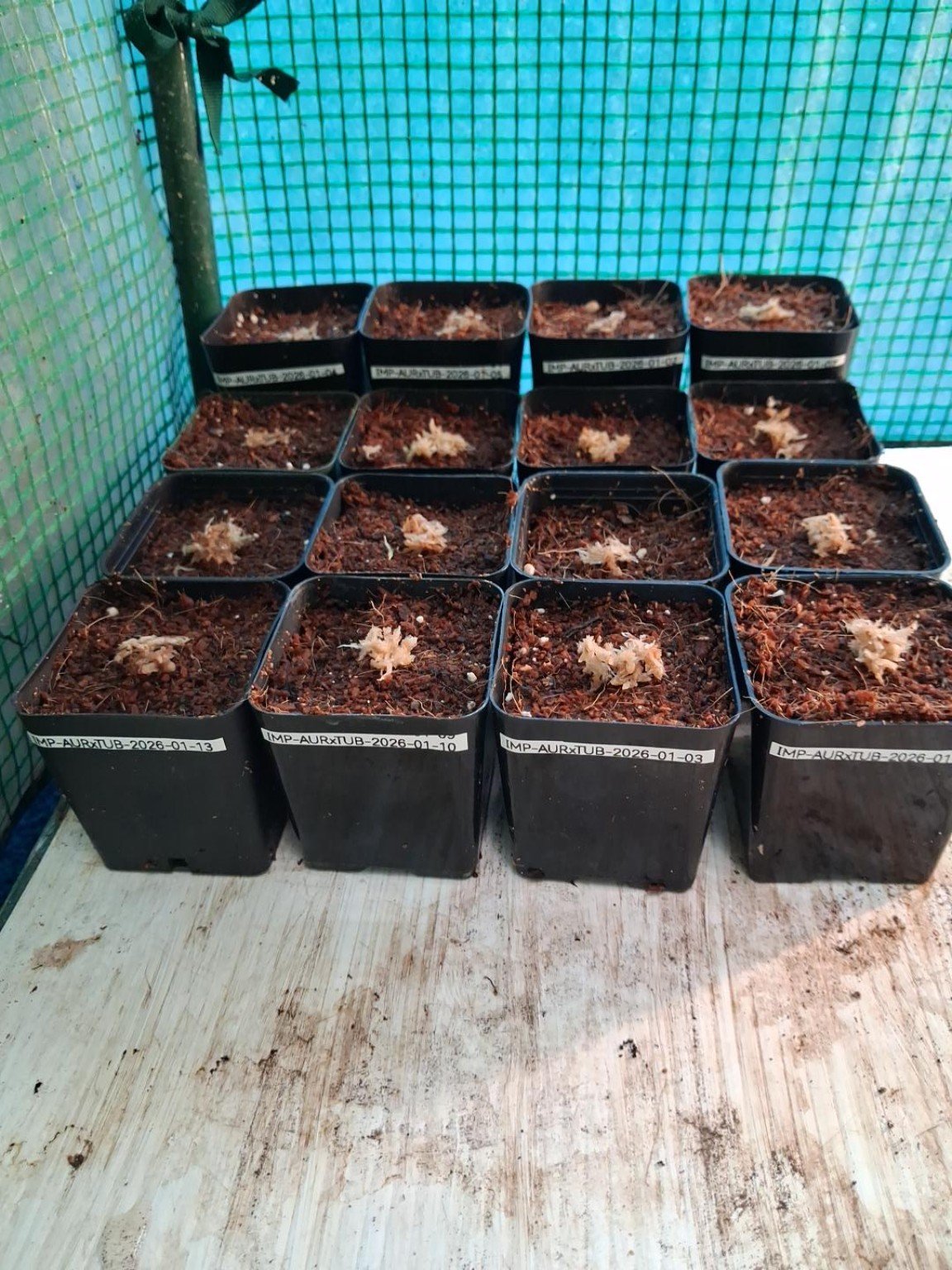
Checkpoint: October 22, 2026. Intended cross: female Impatiens auricoma × male Impatiens tuberosa. Sixteen seeds were recovered from one capsule on October 21. All sixteen were sown October 22, one seed per permanently labeled pot, in premoistened coco-based medium with a thin, light-permeable sphagnum covering.
Cohort IMP-AURxTUB-2026-01 has individual identifiers ending 01–16. The labels preserve each plant's identity even when pots change position. These are putative F1 progeny, not confirmed interspecific hybrids. Germination, viability and parentage still need evidence.
The exact harvested capsule's connection to the October 4 hand-pollinated flowers and the isolation controls remain unresolved. Naming the intended pollen parent does not settle those questions.
The wider program includes I. bicaudata and source-labeled I. usambarensis. Future breeding interests include different combinations involving bicaudata, adenioides, tuberosa and auricoma, with additional Impatiens species planned. Planned participation does not establish that every species has arrived or been crossed.
See the original photographic sequence on Facebook.
Nymphaea thermarum: two individuals, two histories
Checkpoint: October 18, 2026. I track two seed-grown plants separately. Their prior conditions and later composite media differ, so a side-by-side photograph cannot isolate a substrate effect. The off-plant mock-pot phase is closed.
On October 18 I reported that both plants looked better, especially #2. That is a condition observation, not proof of what caused the improvement.
Siphonochilus aethiopicus: emergence and an ash trial
Checkpoint: October 9, 2026. Nine emerged trial pots, two rotted and one firm but dormant were recorded across twelve pots. Treatment groups had only three pots each. Six earlier emergences belong to a separate pre-treatment cohort.
These counts document what happened. They do not establish that ash caused emergence or rot, and an unconfirmed intervention is not recorded as completed.
Dionaea: collection and future breeding
Named flytrap accessions are retained as collection and propagation stock. Cultivar identity and source history stay separate from seed-grown offspring. Breeding interests and preparation are part of the story; a new cultivar or successful cross needs its own evidence.
Keeping the unsuccessful results
A dormant pot, failed seed or unsuccessful pollination is useful information. Recording the method, date and outcome helps us ask a better question next time. These are practical nursery trials, with their limits left visible.