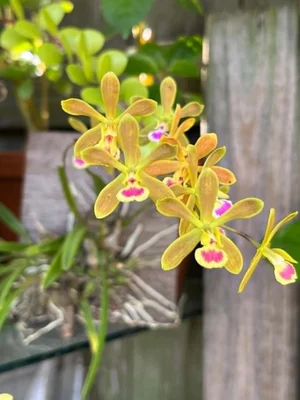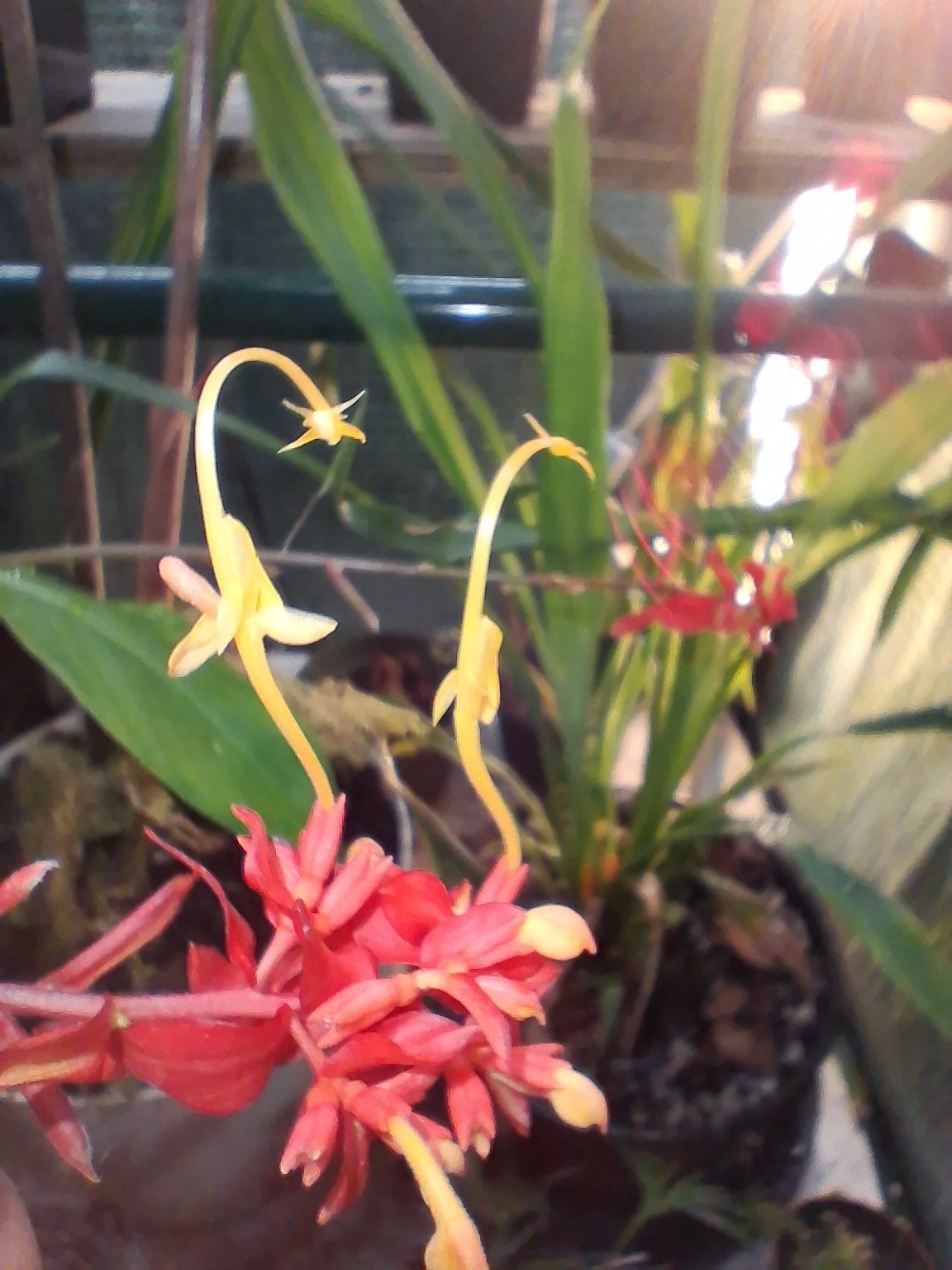
Recorded October 26, 2026. One frame from the five-frame flowering series; nursery identity as labeled.
A flowering plant gives us something beautiful to look at and something useful to investigate. Our nursery photographs recorded on October 26, 2026 show the plant we keep labeled Globba atrosanguinea with red bracts and long, curved yellow floral structures. That series is a starting point for a closer record of how this ginger develops.
Looking at the flowering structure
The whole arrangement of flowers is an inflorescence. Bracts are modified leaves associated with flowers; the red bracts are a conspicuous part of this display. In their study of gingers in Sabah, Julius and colleagues describe G. atrosanguinea with red bracts and yellow-orange flowers. Their account of the genus also draws attention to its long, curved stamen, the pollen-producing part of a flower.
Two close views in our series show the arching yellow structures above the red bracts. Other frames look along the stalk, where small pale structures are visible at several nodes. These views belong to one recorded photographic series. They do not establish how long individual flowers last, how many plants are in the collection or a sequence of changes over several days.
A name and a native range
Kew's Plants of the World Online accepts Globba atrosanguinea Teijsm. & Binn. in the ginger family, Zingiberaceae, and places its native range in Sumatra and Borneo. Those are species-level facts. Our nursery plant remains identified as labeled; its exact source and variety need their own evidence.
Questions worth following
The small pale structures along the stalk deserve follow-up before we assign them a reproductive role. A useful next observation would match the same stalk and structures across dated views: what enlarges, what remains attached and what develops later? This series does not establish viable bulbils, fruit or seed production.
Ordinary growing records matter here too: the actual potting mix, watering pattern, new shoots and seasonal leaf changes. Together with photographs, those observations can build an account of how this particular plant behaves in our nursery. For now, flowering is documented; propagation outcomes and an annual growth cycle remain questions to investigate.
Sources and further reading
Plants of the World Online: accepted name and distribution.
Julius, Takano, Suleiman and Tukin (2010), Zingiberaceae of Maliau Basin, Sabah, Malaysia, Journal of Tropical Biology and Conservation 6: 1–20; see printed page 16 for the Globba account.